


Axiom [beta]
Category
Interactive Installation
Mentor
Hagit Antebi Zohar
Year
2026
We’re used to proving to the internet that we’re not robots, but what happens when proof is no longer enough? An interactive installation based on the Dead Internet Theory, which suggests that the web is gradually being emptied of human presence. In an age of bots, algorithms, and AI, the project puts the most basic assumption to the test: that the user is human.

The context
Axiom [beta] is based on the Dead Internet Theory, a conspiracy theory claiming that much of the activity and content online is no longer created by people. The theory itself is extreme, but it points to a real shift. Synthetic content is becoming increasingly present online, through bot traffic, algorithmic systems and generative AI.
Not long ago, talking to someone online came with a simple assumption: there was another person on the other side of the screen. Today, that is no longer a given. It is becoming harder to know who, or what we are interacting with.
At the same time, the situation has reversed in another way. As users, we are increasingly asked to prove that we are human.
Axiom [beta] takes that shift as its starting point and asks:
What happens when we can no longer prove it? What are the consequences? and more importantly, how does it feel?
The experience
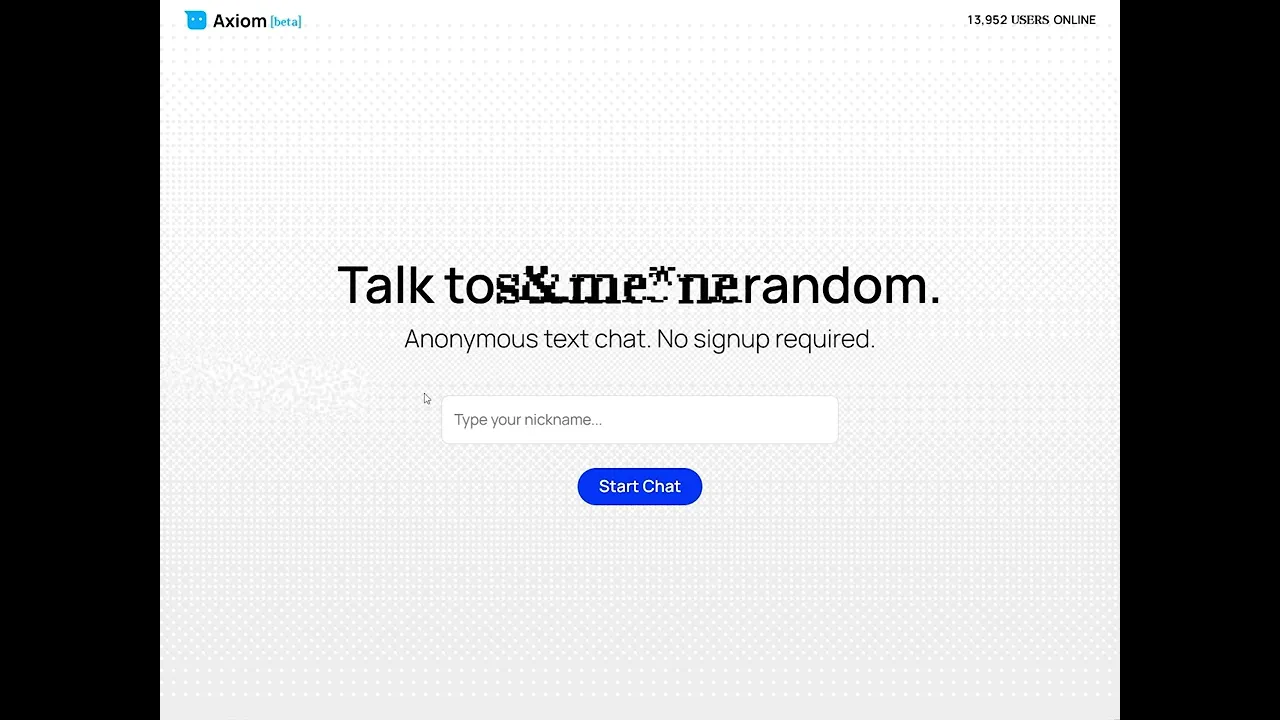
The user enters what looks like an ordinary anonymous chat. At first, everything behaves as expected. Then the conversation begins to break: selected replies change before they are sent, messages glitch, and the person on the other side begins to suspect that the visitor is a bot. Frustrated, she disconnects.
The system then flags the user for suspicious activity and asks them to verify that they are human. What starts as a familiar CAPTCHA process gradually becomes stranger, more personal and increasingly impossible to pass. No matter what the visitor does, every verification attempt fails.
At the same time, two surrounding screens show the visitor’s face live. With every failed CAPTCHA, the image becomes more distorted, until the system reaches its final conclusion…
We couldn’t verify that you’re human.
~4 min
experience
9
tests
3
physical screens
0
ways to pass

The name
Beta
A test version.
By combining the two terms, the name creates a new meaning:
it takes the assumption that the user is human and puts it to the test.
From Simulacrum to Axiom [beta]
The first concept
The project originally began as Simulacrum.
Its premise was much larger: the visitor would enter a fictional early-2000s social network, gradually realise that every account behaved in the same hollow way, search for the one person who seemed different, and eventually discover that no humans were left inside the system.
The early-2000s setting was intentional: nostalgia made the space feel familiar and trustworthy, giving the project something to break later. The concept also drew from analog horror, using familiar interfaces, subtle inconsistencies and slow-building unease.
Conversation scripts
2000's social networks research
Chat wireframe
The problem wasn’t the idea. It was the experience.
While writing the script and building the first flow with my mentor, it became clear that the concept depended on an ideal user.
A visitor at a graduate exhibition has limited time, no context and someone waiting behind them. Asking them to understand an unfamiliar social network, investigate it, follow a mystery and recognise a narrative twist created too much friction before the actual idea could land.
So the concept was reduced to its most immediate form.
Axiom [beta]
One familiar anonymous chat
Human presence is becoming uncertain
You are accused of being one
Verification became the main experience
The visitor tries to pass an impossible test
How the experience works
The installation runs across two connected layers: the interaction on the main screen, and the visitor’s live image on the surrounding screens.
Main screen
01
Chat
The visitor enters an anonymous chat and responds to another user by choosing between three messages.
Gradually, the interface stops behaving as expected. Selected replies are altered before they are sent, messages glitch, and the person on the other side becomes convinced that the visitor is a bot. Eventually, she disconnects.
The anonymous chat
02
Verification
The system detects suspicious activity and sends the visitor into a series of nine CAPTCHA tests.
What begins as familiar verification gradually becomes stranger and impossible to pass. Every failure produces three layers of feedback: an immediate error, a direct response from the system, and a quieter diagnostic layer underneath.
The final CAPTCHA asks the visitor to identify a human using their own live camera feed. It fails too.
The “only fans” test one of nine CAPTCHAs
03
Verdict
The system ends the process with one final conclusion:
We couldn’t verify that you’re human.
The ending screen
Surrounding screens
From the moment the experience begins, two screens display the visitor’s face live.
Every CAPTCHA distorts it in a different way, and within each test, the distortion intensifies the longer the visitor keeps trying.
The harder they work to prove they are human, the further their image is pushed away from looking human at all. By the final test, the face disappears completely.
Because the screens face outward, the process becomes visible to everyone around the installation.
Design decisions
01
Familiar before unsettling
The experience starts as a deliberately ordinary anonymous chat. It needs to feel trustworthy before that trust can be broken.
02
The face becomes the feedback
Visual research showed that human presence is strongly associated with the face. So the installation uses the visitor’s own face as feedback, the harder they try to prove they are human, the less human they appear.
03
Private failure becomes public
The open frame keeps the interaction personal without hiding it from the exhibition space. The surrounding screens turn the visitor’s changing face into something others can witness too.
04
Three layers of failure
Every failed CAPTCHA triggers three layers: a toast, a direct response in red, and a subtle blue diagnosis in the background. The last is intentionally easy to miss, revealing what the system is really concluding.
Failed CAPTCHAs, showing the three feedback layers in action.
Building Axiom [beta]
Design to development
I designed and prototyped the full experience in Figma, then worked with a developer to translate the flows and interactions into a functional website.
Creative development
I also built the reactive visual layers myself in Brik, Wix’s agent-based AI tool, creating the live camera effects and interactive distortions.
At the exhibition
Axiom [beta] was presented at the HIT Visual Communication graduate exhibition in August 2026, where the project received distinction.
The experience was designed to shift gradually from playful to uncomfortable. The first CAPTCHAs often made visitors laugh, but as the system kept rejecting them, the reaction changed: they tried harder, became more frustrated, and only later noticed what was happening to their face on the surrounding screens.
That change in reaction was an important part of the experience, the interaction begins almost like a joke, but gradually becomes personal.

Department reel - introducing the project

Project teaser

Project teaser

