MIND - Mars Intelligent Navigation & Diagnostics
Category
UI/UX Design
Mentor
Netanel Kosovsky
Partner
Omri Shalev
Year
2025
MIND is a remote control system that helps Mars Rover mission teams operate faster, safer, and smarter; surfacing real-time status, historical data, and past mission insights in one place, so teams can make better decisions under pressure and plan future missions with confidence.

The Mission
For this studio project, we were asked to design a complex digital system that enhances a real-world experience. We chose NASA’s Curiosity rover mission, a data-rich, ongoing exploration process combining science, technology, and human decision-making under extreme constraints.
Our goal: translate that complexity into an intuitive digital product, shaped by research, competitive analysis, scenario planning, and a clear visual identity.
2011
Curiosity launch year
4–24 min
one-way command delay
No real-time control
every command is a committed decision
Research insights
01
Dual-horizon planning
Mission planning blends long-term goals with short-term reactive decisions based on incoming rover data.
02
Safety vs. ambition
Mars is unpredictable — every decision balances scientific ambition against rover safety.
03
Constant time pressure
Communication delay and narrow command windows force fast calls, every time.
04
Experience over certainty
Under uncertainty, teams lean on experience and historical data, including pre-mission risk simulations.
05
Knowledge doesn’t transfer cleanly
Team turnover means lessons learned aren’t preserved consistently across the group.
Pain Points
Opportunities
01
How might we help operators check rover status as fast as possible?
02
How might we make it easier to find the right historical data under time pressure?
03
How might we reduce the impact of knowledge gaps between team members?

01
Status at a glance
Rover health, the current mission and the last five events, in one view.
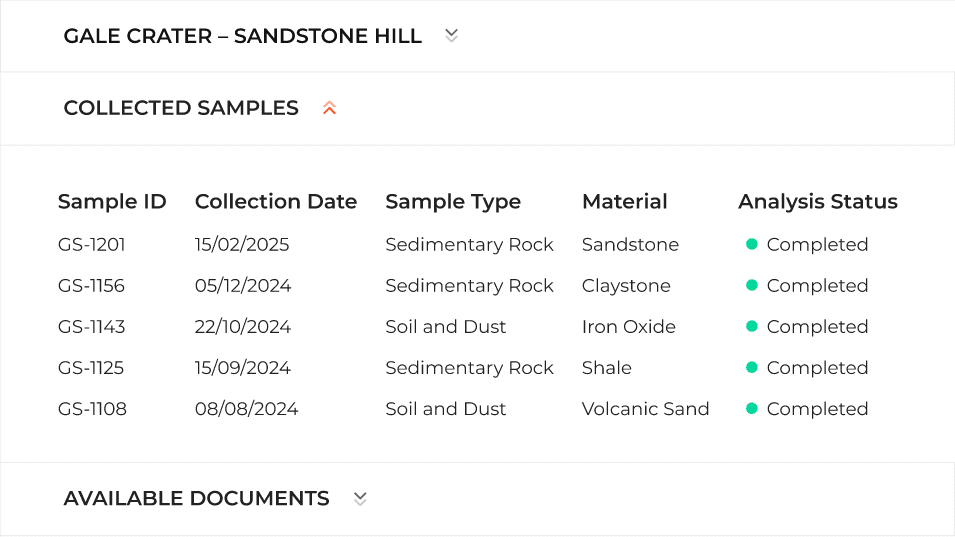
02
Collected samples
Every sample taken at this location, shown while you’re choosing it.

03
Available documents
Reports, images and mission logs stay attached to the location.
Competitive Analysis
Customizable layout
Rearrangeable components
Generic Windows templates
No data hierarchy
Same table for all data
Unlabelled charts and tables
Commands hard to spot
Steep learning curve
Panels collapse so the screen only shows what the current task needs.
Menu by mission stage
Built-in command shortcuts
Dated and cramped
No filtering
Tables look alike
Tiny, error-prone controls
Creating a mission runs as a step-by-step wizard, with filtering and sorting on long lists.
Most modern, accessible UI
Icon + count sidebar
Map-first command sending
Step indicator
Inline help
Busy image backgrounds
Step indicator buried
Steps stay pinned to the top of the screen; navigation is a simple icon sidebar.
AmbaSat
Kit for building, programming, and launching mini satellites, with a dashboard for real-time telemetry.
Scannable bento-grid
Next communication window
Timeline for mission status
Gauges that don’t fit the data
Confusing split maps
Sensor graphs without labels
Menu disguised as boxes
Everything is the same size
The dashboard uses a bento-grid layout, readable at a glance, surfacing the mission timeline and next communication window.
Design evolution
Wireframe
Sketch
Final design
The Solution
MIND is a remote control and mission management system built to give control teams clarity, speed, and confidence.
It combines live diagnostics, historical archives, and past mission data in one interface, directly answering the questions research surfaced: faster status checks, faster access to relevant history, and a shared record of lessons learned across teams.
Main dashboard
rover health, the current mission and open incidents in one view.
New mission
choosing the mission objective.
New mission
choosing the target location, list and map side by side.